


By ,
Sep 29, 2025
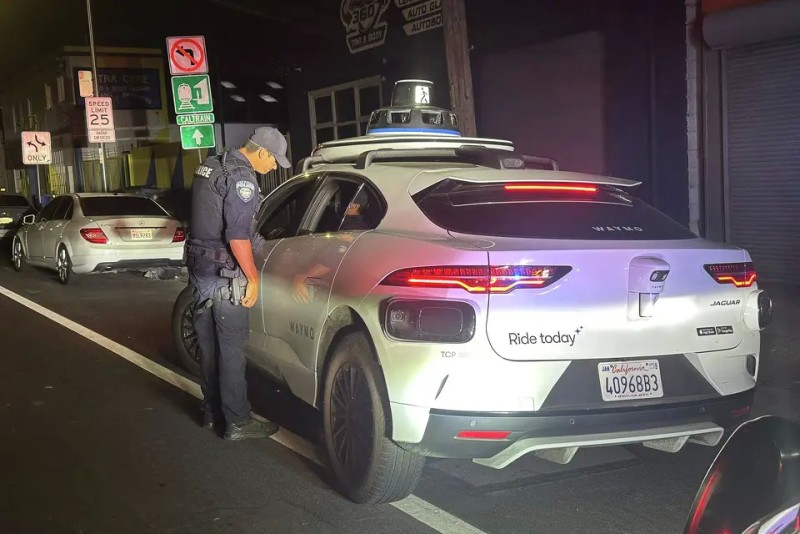
One of Waymo’s driverless cars was pulled over in San Bruno during a DUI enforcement operation after making an illegal U-turn. - San Bruno Police Department
When San Bruno police pulled over a robotaxi for making an illegal U-turn on Friday, in what became an instantly viral, publicly scrutinized traffic stop that soon overwhelmed the small Peninsula city, officers said they were powerless to write a ticket.
But that doesn’t mean the Waymo they stopped — and the tech giant behind it — will face no consequences.
Officers conducting a DUI sting spotted the driverless car close to midnight, as it headed west down San Bruno Avenue toward Huntington Avenue. There, the Waymo flipped a turn in spite of a no U-turn sign posted at the intersection, according to traffic Sgt. Scott Smithmatungol. He said the Waymo yielded to emergency lights on San Mateo Avenue, just north of San Bruno Avenue.
“Because autonomous vehicles are relatively new in San Bruno within the last few months, officers have seen these autonomous vehicles have drivers in them in the past,” Smithmatungol said, explaining the rationale for the stop. After finding no one behind the wheel of the robotaxi, police called a “remote representative” of Waymo, which is owned by Alphabet.
Meanwhile, questions swirled after an official incident summary, accompanied by a humorous photo of a police officer staring down at the empty driver’s seat, started to ricochet on social media. Among people’s questions about the bizarre incident: Who gets the ticket when a driverless robotaxi is pulled over for a traffic violation?
Ultimately, police declined to write a citation, saying their forms “don’t have a box for ‘robot.’ A new state law will empower police to issue notices of violation directly to companies when their cars break traffic rules, but it won’t take effect until next July.
As autonomous vehicle companies rapidly expand their reach in the Bay Area and other cities, Waymo has vigorously promoted its safety records to build public trust. “We are looking into this situation and are committed to improving road safety through our ongoing learnings and experience,” representatives of the company wrote in a statement that provided no additional information about the episode.
Some observers, including Matthew Raifman, a researcher at UC Berkeley’s Safe Transportation Research and Education Center, saw the U-turn stop as a sign that Waymos and other autonomous vehicles are fallible and prone to miscalculations, even as they get more sophisticated. Although AVs no longer get waylaid by heavy fog or traffic cones, and have figured out how to navigate through emergency scenes, they still commit errors on the roads.
In June, for instance, Raifman observed a Waymo park for 5 minutes in a bike lane on Washington Street, partially blocking traffic so that cyclists and other cars had to swerve around it.
“We’re in a situation with AVs in society where the norms are being established and tested,” Raifman said. He noted that since the AV companies tout their ability to map roads and analyze conditions using cameras and sensors, regulators need to decide whether to hold them to a higher standard than the average human driver.
Yet other experts, like University of San Francisco engineering professor William Riggs, say AV companies are already under a microscope from the California Department of Motor Vehicles, which has the power to impose fines or suspend and even revoke licenses to operate. In 2023, the department indefinitely stopped California operations for General Motor-owned Cruise, after one of the company’s cars struck a jaywalking pedestrian.
“These kinds of minor illegal U-turn activities are much less concerning” than human misbehavior, such as drunken driving, Riggs said.
Nonetheless, he acknowledged that each highly publicized mishap involving a Waymo causes reputational damage to the still-emerging technology.